
Web development is gradually changing. Tasks that once required JavaScript, additional libraries or complicated CSS solutions can increasingly be handled by the browser itself.
That trend continues throughout 2026.
The Baseline project from web.dev provides developers with a clearer way to understand which web platform features are broadly available in modern browsers.
New CSS capabilities
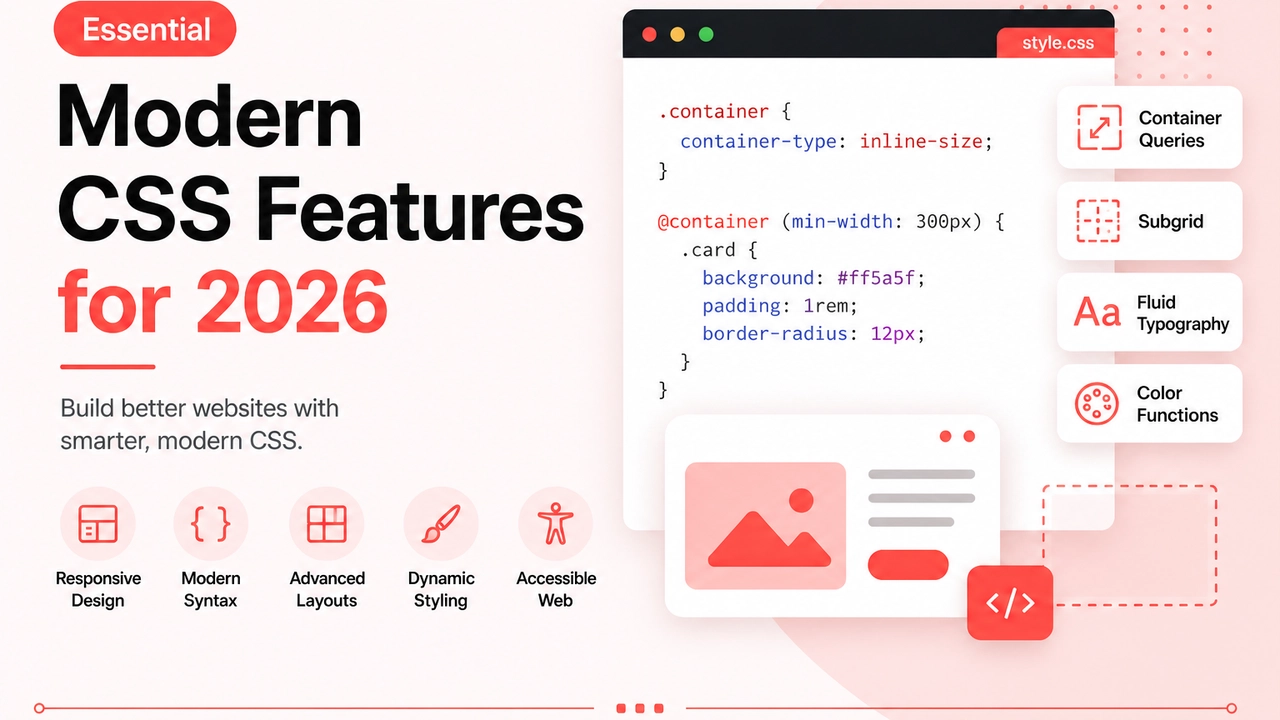
Baseline 2026 includes features such as field-sizing, container style queries, :open, contrast-color() and several other CSS and HTML capabilities.
The importance of these features goes beyond simply adding new syntax to CSS.
They allow developers to move more interface logic closer to the platform itself. In practical terms, this can make responsive components easier to build without creating separate JavaScript logic for every scenario.
The potential result is simpler code, fewer dependencies and more maintainable component architectures.
Progressive enhancement still matters
The arrival of a new browser feature does not mean it should automatically be used everywhere.
The Web Features Explorer recommends taking browser support into account and using progressive enhancement. Core content and functionality should remain available even when a particular modern feature is not supported by a user's browser.
This is particularly important for commercial websites, where visitors use a wide range of browsers, devices and software versions.
Less JavaScript where the platform can do the job
One of the interesting developments in modern web development is the gradual movement of certain interface capabilities from JavaScript into native HTML and CSS.
That does not make JavaScript irrelevant. It remains essential for modern web applications.
However, when the browser can handle a specific task natively, adding another dependency or custom script may no longer be necessary.
For users, this can potentially mean fewer resources to download. For development teams, it can mean less code to maintain.
What this means for businesses
For website owners, the arrival of new web platform features does not mean that every existing project needs to be rewritten.
A more practical approach is to periodically review the technology stack and identify places where a third-party solution may no longer be necessary.
As browser capabilities improve, some projects can gradually reduce dependencies, simplify their codebase and make interfaces easier to maintain.
In 2026, the web platform is continuing in that direction: more functionality is becoming available through the browser itself rather than through layers of additional tooling.